
Hybrid Management: Agile in early stages, V-model for industrialisation

Hardware Agility does not replace the V-model, it complements it.
The exploration and technical validation phases benefit from short iterations to reduce risk. Industrialisation then follows a proven sequential process.

  • Iterative validations in the early stages
  • Controlled transition to industrialisation
  • Compatible with ISO 9001, ISO 13485, GMP, DO-178C
 Request a free presentation

How to combine Agile and the V-model

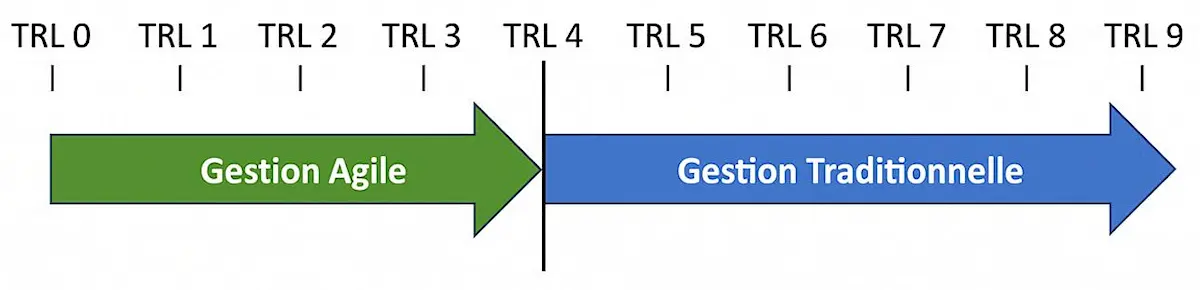
Example of hybrid management: Agile to V-model transition at TRL4
Example of a hybrid model with transition at TRL4 (the transition point varies depending on your context)

Early stages: Agile iterations

The exploration, feasibility and technical validation phases are characterised by uncertainty. Short iterations make it possible to:

  • Progressively validate technical choices
  • Integrate user feedback rapidly
  • Reduce risks before committing to industrialisation
  • Deliver functional proofs of concept at each cycle (2 to 4 weeks)

Industrialisation: the V-model

Once the product is stabilised, industrialisation demands rigour and traceability:

  • Frozen and validated specifications
  • Sequential process with formal milestones
  • Locked-down supply chain
  • Regulatory compliance assured

Our articles on Agility | Case studies

Adapt this model to your context

Every sector, every organisation has its own constraints. We support you in building a bespoke hybrid management model.

When to switch from Agile to the V-model

The transition between iterative and sequential approaches is not arbitrary. It relies on objective criteria that ensure the product is ready for industrialisation.

Transition checklist

  • Proof of concept validated: core functionalities confirmed by users
  • Specifications frozen: specifications document stabilised, accepted by stakeholders
  • Regulatory requirements validated: ISO, GMP, DO-178 compliance integrated
  • Supply chain locked down: qualified suppliers, components selected
  • Industrial process defined: production facilities, tooling, operating procedures ready
  • Risks under control: major uncertainties have been resolved

Common mistakes to avoid

  • Switching too early: committing to industrialisation whilst technical uncertainties remain leads to costly changes in later phases.
  • Switching too late: extending iterations beyond what is necessary slows time-to-market and increases development costs.
  • Lack of formal milestones: without objective criteria, the decision becomes subjective and a source of conflict.
  • Neglecting traceability: iterative working does not exempt teams from documenting technical choices for the industrial phase.

Compatible with your standards and frameworks

The hybrid model has been designed to integrate regulatory constraints from the outset, not as an afterthought. Normative requirements structure the early-stage iterations and guarantee a smooth transition to industrialisation.

ISO 9001

Decision traceability, document management, design reviews at each cycle. Iterative deliverables feed directly into the quality system.

ISO 13485

Medical devices: risk management (ISO 14971) integrated into cycles, DHF (Design History File) progressively populated.

GMP (Good Manufacturing Practice)

Pharma & biotech: formal equipment validations, IQ/OQ/PQ protocols prepared during the Agile phase, executed during the industrial phase.

DO-178C

Aerospace: certification objectives defined from the earliest cycles, automated requirements-to-tests traceability, audits at each milestone.

Key principle: Normative requirements are not a barrier to hardware agility, they define its guardrails. Each iteration respects the quality and regulatory criteria applicable to the current development phase.

Ready to embrace Agility?

Training, coaching or a simple conversation - we are here to help